10. Whitney
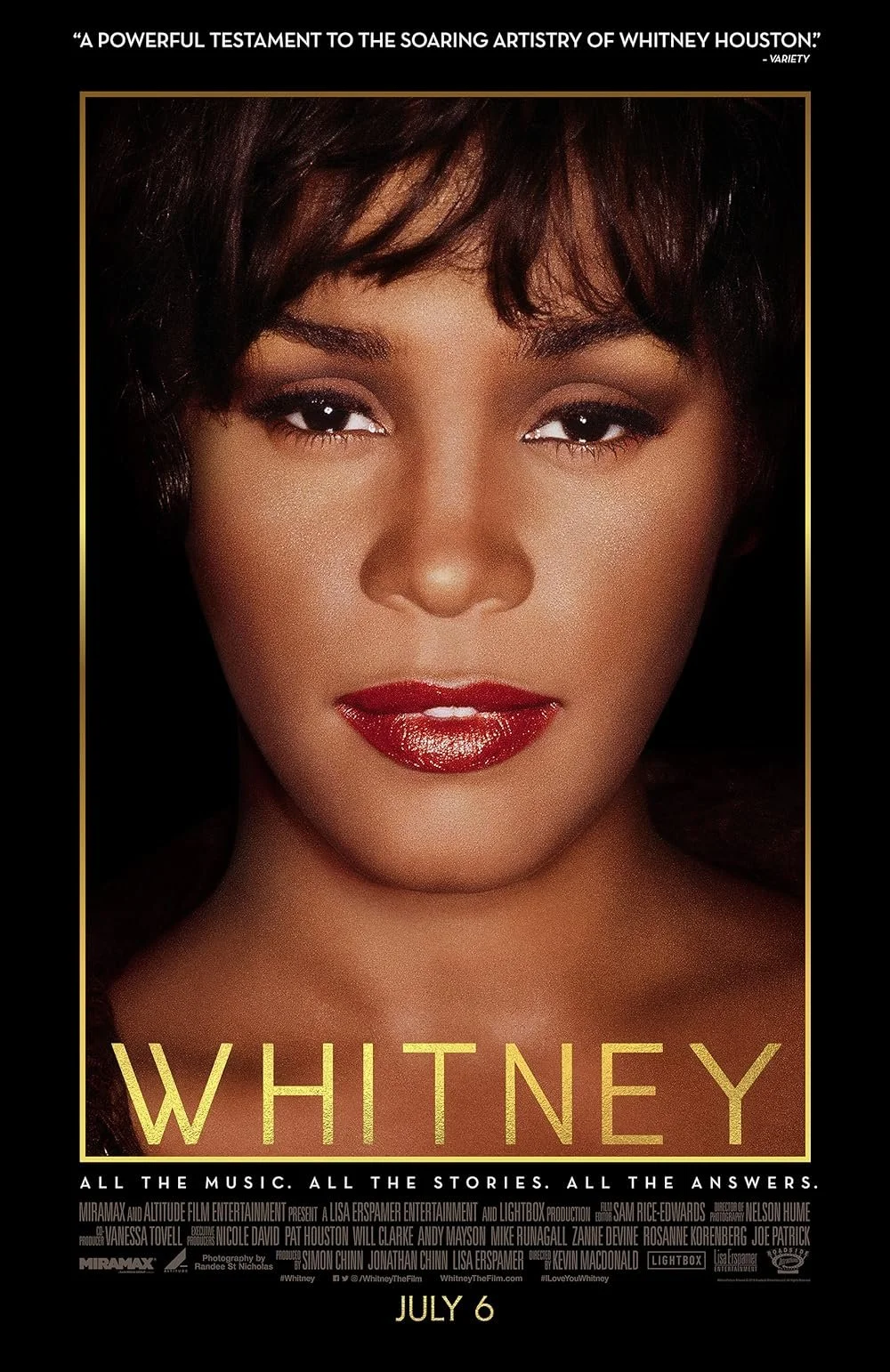
I didn’t know much about Whitney Houston apart from “I Wanna Dance with Somebody” before watching Whitney in class. To me, the woman was inseparable from her biggest hit. After viewing a detailed review of her imperfections, her desires, her dichotomized identities, I cannot help but be mesmerized by Whitney. How could she not fall victim to the damming pressure suffocating her from every direction? Family, romance, celebrity, sexuality, drugs, passion, commodification, blackness.
My love for documentaries combined with my little knowledge about Whitney left me with no critiques about the project. I applaud the film’s portrayal of Whitney; she was handled with care. While all stories have some inherent bias, I felt that Whitney’s story was being told rather than crafted. Her victories and mistakes were highlighted, allowing the viewer to see the woman on the screen as a human rather than a celebrity.
Whitney’s celebrity and Blackness created a double bind so prominent, it haunted her professional and personal life until her death. Her Blackness impeded on her Commodified Celebrity. Specifically, her sexual rebellion, drug abuse, and absent motherhood practices align with the Crack Mother stereotype. While her packaging was constructed air-tight, her issues eventually seeped through, and once fans saw Whitney on drugs, she was rejected quickly and without second thought. She was closer to the Crack Mother than the wholesome girl-next-door from Newark, NJ.
Meanwhile, her Commodified Celebrity restricted her Blackness. Whitney was not truly welcome by black or white communities; she existed in a new in-between. She was dubbed ‘Whitey Whitney’ by the Black community but shocked the white community when she kissed a white man. Black America, knowing of the corruption and drugs, watched as Whitney was sold as a good girl. She was known by Black America as a fraud, a liar. With authenticity ripped from her public persona, the Black community never welcomed Whitney.
The project laid her humanity bare, and I found myself wanting to learn more about her. I wanted to be her friend. I learned she was romantically involved with women and men. I learned about the cracks in her familial life and that she was a mother. I was shown the extent of the drug use and abuse. I got to see her struggles within the Black community. I watched her cling to her passions like a lifeline. By the end, I just wanted to hold Whitney’s hand.
Madeline’s Weekly Favorites
In no particular order and for no particular reason.